ClarityAI: Get help to focus right
In this article I introduce a new product idea: ClarityAI - The platform to help people get clarity on their ideas and to focus on what matters most.

What is it?
The platform to help people get clarity on their ideas and to focus on what matters most.
Problem:
You have 1000 ideas and get new ones each day every day and wonder: which one shall I work on, which one should I focus on. And in general, how do I even know what to do next? How do I find clarity with what I want to do? And what to do next?
Result of the Problem:
Losing money, focus, perspective
Result of the Problem of the Problem:
Losing career, perspective, loved ones who are getting annoyed by your constant switching, flakiness
Vision:
A platform that helps you to get more clarity. A chatbot that helps.
Vision Concept in Detail:
ClarityAI is a SaaS product designed to help people achieve clarity across all their ideas—whether business, creative, or personal projects. The platform empowers users to understand what to work on, how to determine their next steps, and provides comprehensive analysis of their ideas' potential.

Core Features & Capabilities
1. Idea Capture & Storage
2. Intelligent Contextualization & Clustering
3. Personal Profile & Self-Understanding
4. Market Intelligence & Analysis
5. Comprehensive Idea Evaluation
6. AI Clarity Coach
7. Human Connection & Expert Support
First Marketing Flyer a la Claude AI:
https://clarifyai-marketingbanner.netlify.app/ → Check it out, and when you want to sign up, write me a DM and let me know, the “Start Free Trial” Button does not work.
Random Note:
When you want to use that Marketing Banner, change the text and make that button interactive for yourself, feel free to copy paste the Github Repository - https://github.com/frederikeff/ClarifyAI-marketingbanner
First Marketing Images a la Claude and Whisk:
Let’s showcase the Before/After Transformation for our users:

This transformation shows everyone signing up to ClarityAI what they get after they have interacted with the product and platform.
Then we can show some features, like the AI Coaching Chat experience
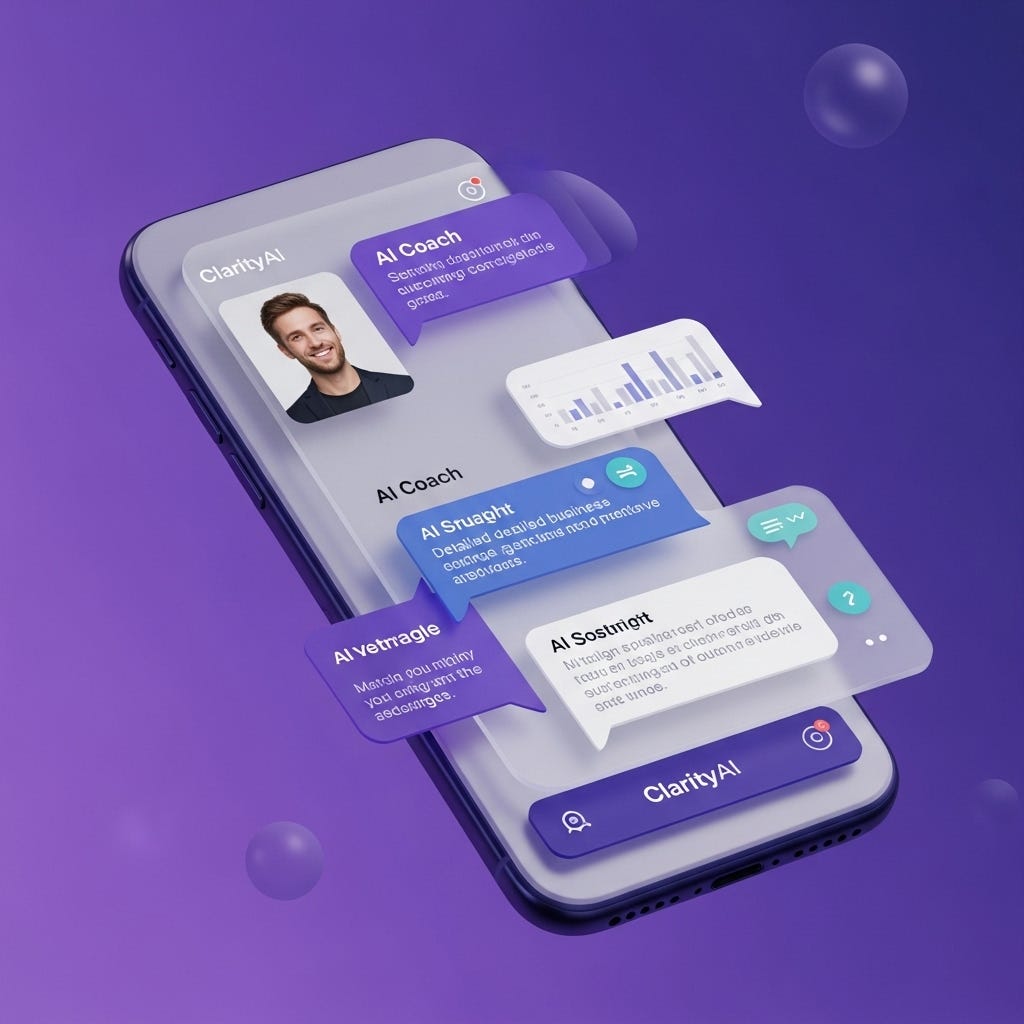
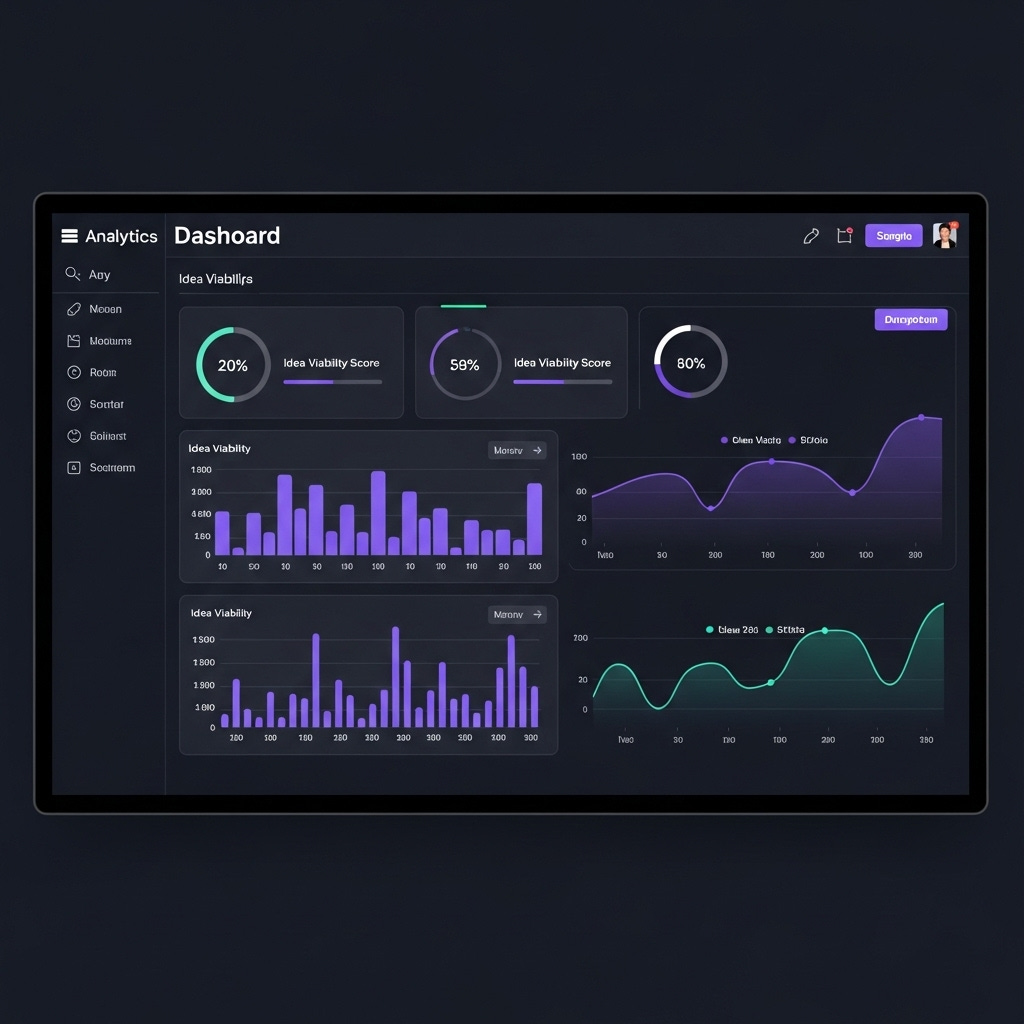
Note: In a real story, you would use non-AI images or make sure the text is well-read - Tip on Whisk for that: Let the AI Prompt run more than once, normally the quality of the text gets significantly better over 2-3 iterations, after that it gets worse again. Then we show how the dashboard could look like
Then it’s all about the human collaboration

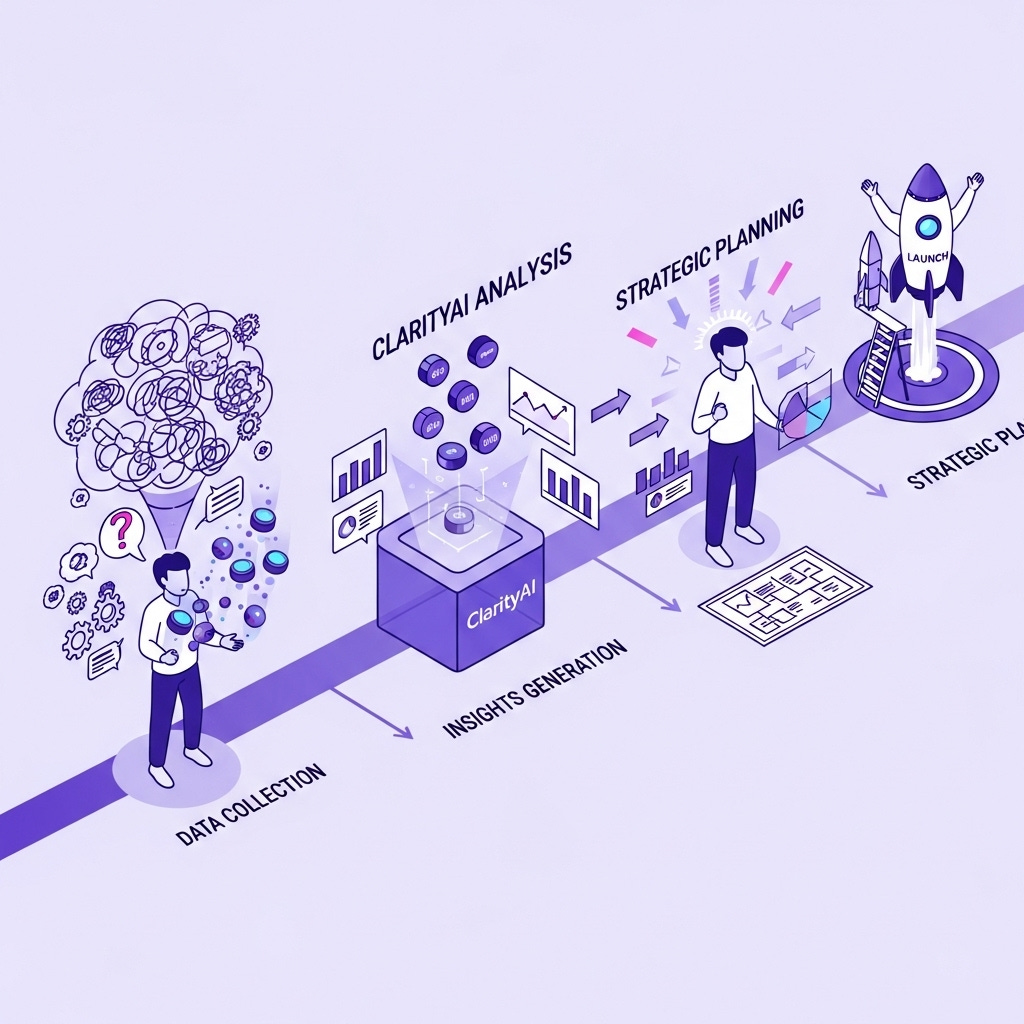
And last, here is the full user journey that ClarifyAI offers its users:
Target Group:
Entrepreneurs, especially Aspiring Entrepreneurs at the beginning of their journey, Sidepreneurs, and all those that want to run specific projects, potentially also Intrapreneurs, Investors, Investor Groups
Implementation a la Gemini AI:
High-Level Architecture
To build a product as dynamic and AI-centric as ClarityAI, a modular and scalable architecture is essential. The proposed stack is designed for rapid development, real-time functionality, and the ability to handle a high volume of AI-driven interactions.

Front-End: React.js for building a responsive and interactive user interface. This will handle the visualization of ideas, the conversational AI chat interface, and the user-facing forms for capturing ideas.

Back-End: Firebase (specifically Firestore for the database and Authentication for user management) is an ideal choice here. Firestore's document-based structure is perfect for storing and organizing each user's ideas, projects, and AI-generated analyses. It also offers real-time syncing, which is great for the conversational and collaborative features.

AI Core: The Gemini API will be the central engine for all AI-powered features. It can be called directly from the back-end to handle complex natural language tasks, data analysis, and conversational coaching.

Feature Breakdown and Implementation
1. Saving Ideas
How to Build It: You would use Firestore as the primary database. Each user would have a dedicated collection of their ideas. A simple form on the front-end (React) would capture the idea's details, and a function would save this information as a new document in the user's Firestore collection.

Firestore Document Structure:

{
  "userId": "user123",
  "ideaTitle": "ClarityAI App",
  "ideaText": "An app to help people get clarity on their ideas...",
  "tags": ["SaaS", "AI", "Productivity"],
  "createdAt": "2025-08-23T13:00:00Z"
}

2. Contextual Clustering & Visualization
How to Build It: This is a two-part process.

Back-End (AI): When a user saves an idea, a back-end function would send the ideaText to the Gemini API. The AI model can analyze the text and generate a vector embedding—a numerical representation of the idea's meaning. These embeddings would be stored alongside the idea in Firestore.

Front-End (React): A visualization library like D3.js or Recharts would then use these embeddings to plot the ideas on a 2D or 3D graph. Ideas with similar embeddings would be placed closer together, creating visual clusters.

3. User Understanding
How to Build It: The Gemini API would act as an analytical coach. It can analyze the aggregate content of a user's ideas—their themes, keywords, and tone—to generate insights about their interests, strengths, and even potential psychological motivations. This analysis would be an ongoing process, with new insights being added to a user profile document in Firestore as they add more ideas.

4. Market & Client Understanding
How to Build It: This can be integrated into the AI coaching conversation. A user could prompt the AI to "analyze the market for this idea." The Gemini API can then use its extensive knowledge to discuss market segments, potential competitors, and user needs based on the idea's description. For more detailed, real-time data, you would need to integrate with external market research APIs, but that could be a future step.

5. Analysis and Discussion
How to Build It: This is the core of the AI coach. The front-end would have a chat interface. Each time a user sends a message, it would be passed to the Gemini API along with the context of the user's ideas and previous conversations. The Gemini model would then generate a response that acts as a coach, asking probing questions, providing analyses, and helping the user navigate their ideas. The "upvoting/downvoting" and "3rd party" features would be managed as simple data points on the idea documents in Firestore.

6. AI-First Approach
How to Build It: The Gemini API would be used for all critical functionalities. For example:

Idea Tagging: The AI could automatically suggest tags for new ideas.

Viability Scoring: The AI could be prompted to "rate this idea on a scale of 1-10 for viability" and provide a detailed explanation.

Problem Identification: The AI could analyze a cluster of ideas and identify a core problem the user is trying to solve.

7. Human Coaching and Supervision
How to Build It: This would be a separate module built on top of the existing architecture.

Booking System: A simple booking feature using Firestore to store session times, participants, and session types (1:1 vs. group).

Video Integration: For the actual sessions, you would integrate a third-party service like Daily.co, Twilio Video, or another real-time communications API. These services provide the infrastructure for video calls, screensharing, and more.
Wanna help build that product and work on solving that problem, let me know :)
For now, see you next time for another product idea and innovation!